
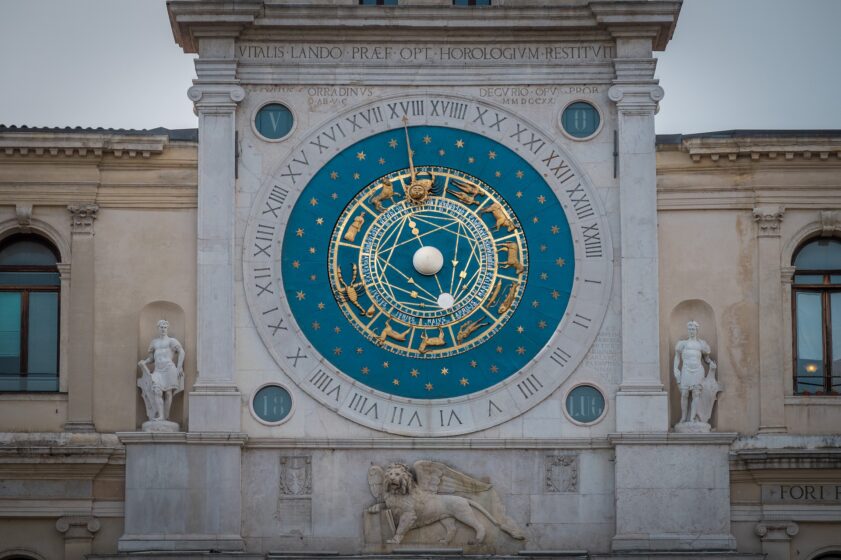
This clock is considered a symbol of excellence by locals. It stands out in Piazza dei Signori, the central square and main reference point in Padua, counting the time day after day in the historic centre.
It is an astronomical clock, that tells us the lunar phases and the position of the planets. It represents the summa of our ancestors’ knowledge of the Universe in the scholarly Padua of 1300, the golden century of our city.
A technical, artistic and engineering masterpiece, the astronomical clock in Padua represents a jewel that deserves to be known and visited.

A journey through the history of the astronomical clock in Piazza dei Signori
The astronomical clock set in the Tower is the most ancient of its kind in the world.
The medic and astronomer Jacopo Dondi started designing it in 1344, at the request of Prince Ubertino da Carrara of Padua, still today known by the nickname ‘Dondi dall’Orologio’.
Destroyed by fires and incidents of war in 1390, the astronomical clock was rebuilt in 1427 by the Venetian Republic.
Reconstruction works began thanks to the horologist Matteo Novello. Work was completed in 1436 by Giovanni and Gian Pietro Dalle Caldiere. The unveiling of the new masterpiece took place in 1437 for the traditional festivities of the Celebration of Sant’Antonio (Saint Anthony).
In 1532 Giovanni Maria Falconetto adorned the façade of the Clock Tower according to the stylistic architectural style of the Renaissance, making several changes.
The astronomical clock in Piazza dei Signori: an extraordinary time machine
The clock is made up of four circular quadrants and one inner band.
The quadrants represent the hours (in Roman numerals), minutes (that advance in multiples of five), days and months.
The circular inner band indicates the hours (in Roman numerals), the lunar phases and the astrological signs.
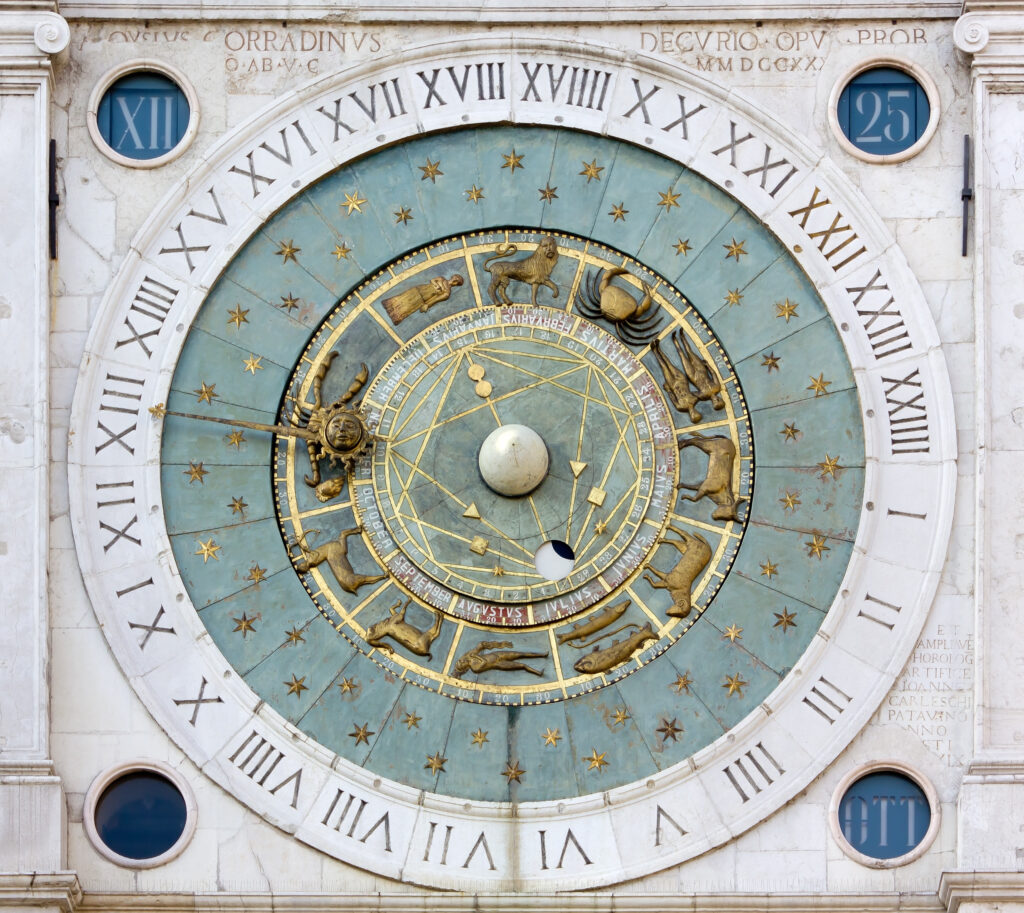
Here are the elements that tell us every day the lunar phases and position of the planets:
- The sky-blue façade with the Sun and Stars
- The Earth, represented as a white circle fixed in the centre of the central quadrant, as per the Aristotelian/Ptolemaic system used at the time
- The Moon, that has a different appearance every day because it moves to complete the full circular cycle every 29.5 days. It will appear completely black during a new moon, completely white if it’s a full moon and you will only see a sliver of it in intermediary stages, just like the moon will appear to the naked eye in its various lunar stages.
- A circular strip with the months written in Latin.
- Another section divided into 14 images are the constellations: the ancient symbols inspired by animals in which our ancestors had grouped the main clusters of visible stars. One of the clock hands will tell you what time of year it is.
The clock tower is 30 metres high and has five floors. The first three contain the clock’s mechanisms, while the last two were used as the clock master’s lodgings, whose job was to look after and maintain the clock.
How does the astral clock work? Find out with a guided tour
Until a couple of decades ago, the accuracy of the astronomical-astrological clock was guaranteed by the clock master and expert horologist that lived in the tower.
You will be able to discover what life would have been like living in the tower by visiting it, with the added bonus of a fantastic view of the square from a little window up in the tower.
The inside of the tower, with the astral clock, can be visited to admire the engineering systems of all the components thanks to a deal that was made between the Council of Padua and Salvalarte (Save the art), the part of the Legambiente association whose volunteers highly value the artistic heritage of our city.
To adhere to pandemic safety regulations, booking is now mandatory in order to make a visit.
A curiosity
Among the zodiac signs represented in the astronomical clock of Piazza dei Signori, you will find that the scales that represent Libra are missing, the symbol of justice, yet Scorpio’s scorpion, symbol of he/she that does not forget, takes up two quadrants.
Is this perhaps the designer’s revenge towards a less financially generous client? Was it a political provocation towards the unjust and disliked Venetian lords? Or a mistake made by the astronomers and astrologers that designed the clock? It was none of these.
The Libra scales don’t appear among the Zodiac signs on the Paduan clock because the theoretical reference that was used was of Greek astronomy, in which Libra had not yet been defined as a constellation in its own right (the Arabs would do that) and its stars were still considered as part of Scorpio.
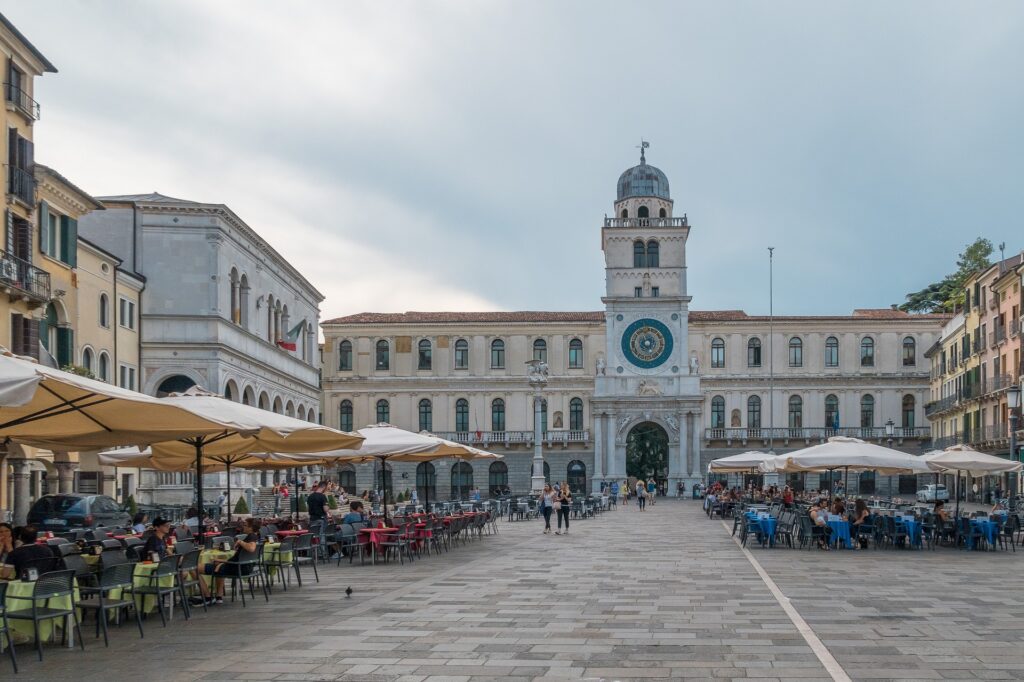
You should know that in Padua there is a rumour that the Libra symbol is hidden in another place in the Piazza dei Signori, probably on the marble base of the flagpole. Is it true? Come to Padua to find out for yourselves!
Location
Piazza dei Signori
Distance from ApartmentsPadova: see map
Photos via:
pixabay.com
shutterstock.com