
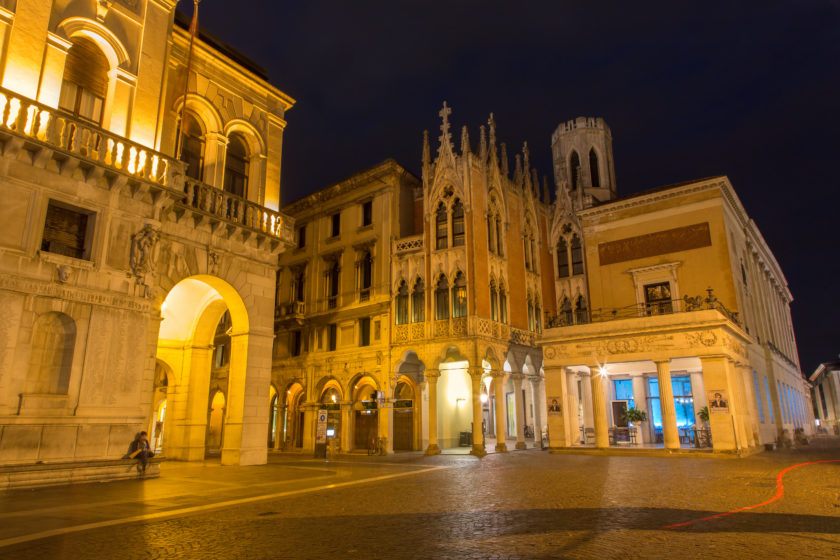
If you find yourselves in Padua, visiting the Pedrocchi Café is a must. Because the Pedrocchi Café in Padua isn’t just any café, and it’s not even just one of Italy’s historical cafés: it’s part of the history and identity of the city, like Prato della Valle and the Basilica of Saint Anthony, belonging to the memory of every person that’s been here.

In the heart of Padua, the “café without doors”
The history of the Pedrocchi Café started with Francesco Pedrocchi of Bergamo who in 1772 opened a “small coffee shop” in a not very strategic place in the city to say the least: not far from the University, the City Hall, markets, main squares, theatre and the post office and the Noli Square (today Garibaldi Square) from which at the time the coaches and carriages left.
His son Antonio, inheriting his father’s thriving business in 1800, immediately showed entrepreneurial skills, deciding to invest the profits by buying the adjacent businesses.
So in 20 years he owned the entire block: an area that was roughly triangular bordered on the east by Via della Garzeria (today Via VIII Febbraio), on the west by Via della Pescheria Vecchia (today an alley called Vicolo Pedrocchi) and on the north with a chapel called Oratorio di San Giobbe (now a little square called Piazzetta Pedrocchi).
To make the new business he put the engineer and architect Giuseppe Jappelli in charge, who designed an eclectic building mixing Neoclassic and Gothic Venetian styles, with exotic Egyptian and Chinese touches that were very fashionable at the time.
The café in Padua that is open day and night
Antonio Pedrocchi chose to split the space into two areas: the “Ridotto”, dedicated to welcoming high society, formal balls and elite cultural meetings; the “Caffé”, that hosted anyone who came and was open day and night. The 24/7 opening hours were adopted until 1916. That’s why even today Pedrocchi is known as the “café without doors”.
Pedrocchi Jr. had a truly unique way of treating with his clientele. According to his own morals, in fact, no one should ever be denied “a glass of water, a pinch of tabacco, a needle and thread to mend a dress and an umbrella”.
Everyone could sit at a table without ordering something and reading the books and newspapers available around the café. Women were offered flowers as gifts and, in cases of sudden rain, customers were leant umbrellas. Customer service doesn’t get much better than that…
A cultured and refined clientele
In the 19th century the Pedrocchi Café was the go-to place for meetings among intellectuals, writers, artists, directors, journalists, students, university professors and politicians.
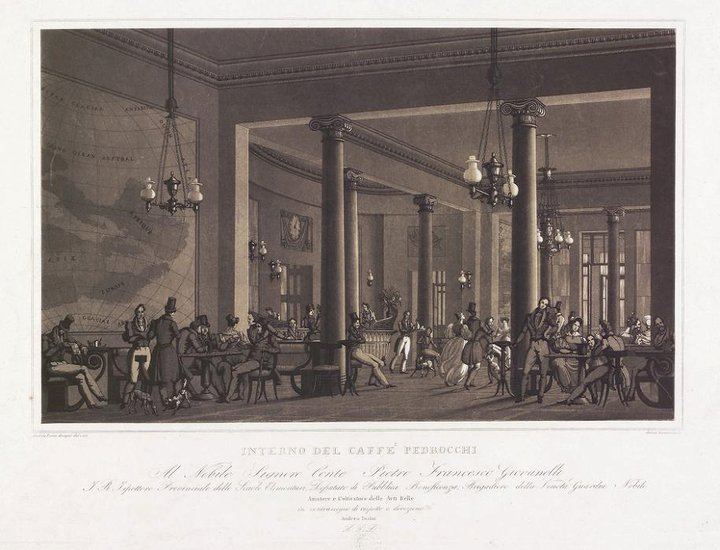
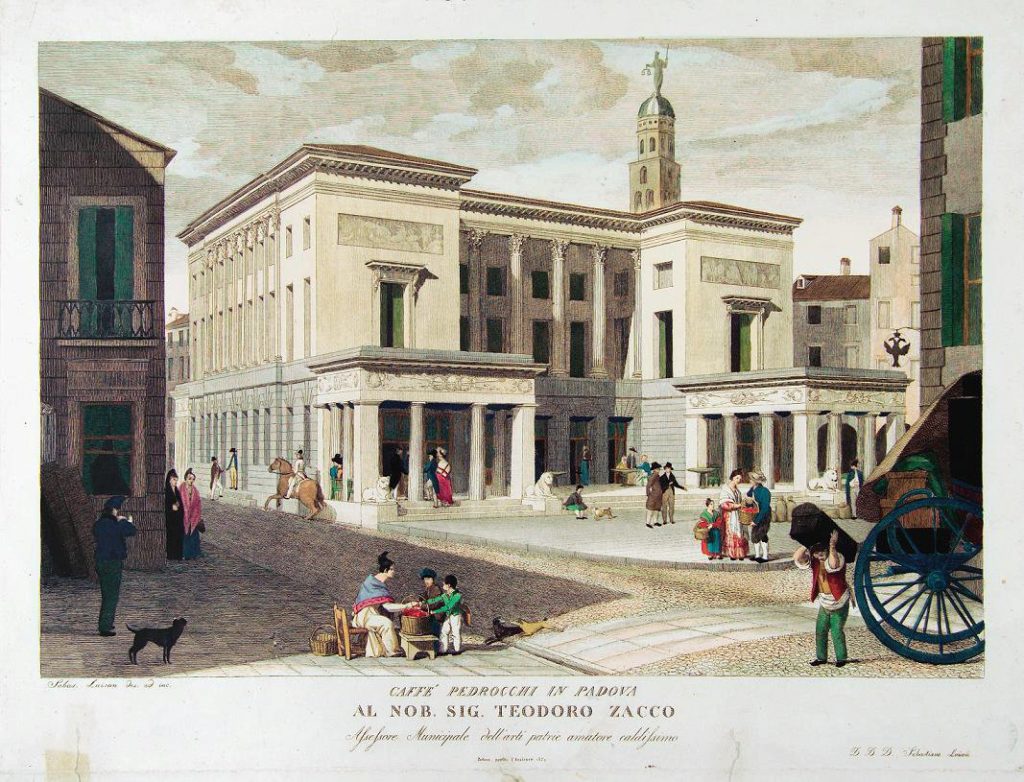
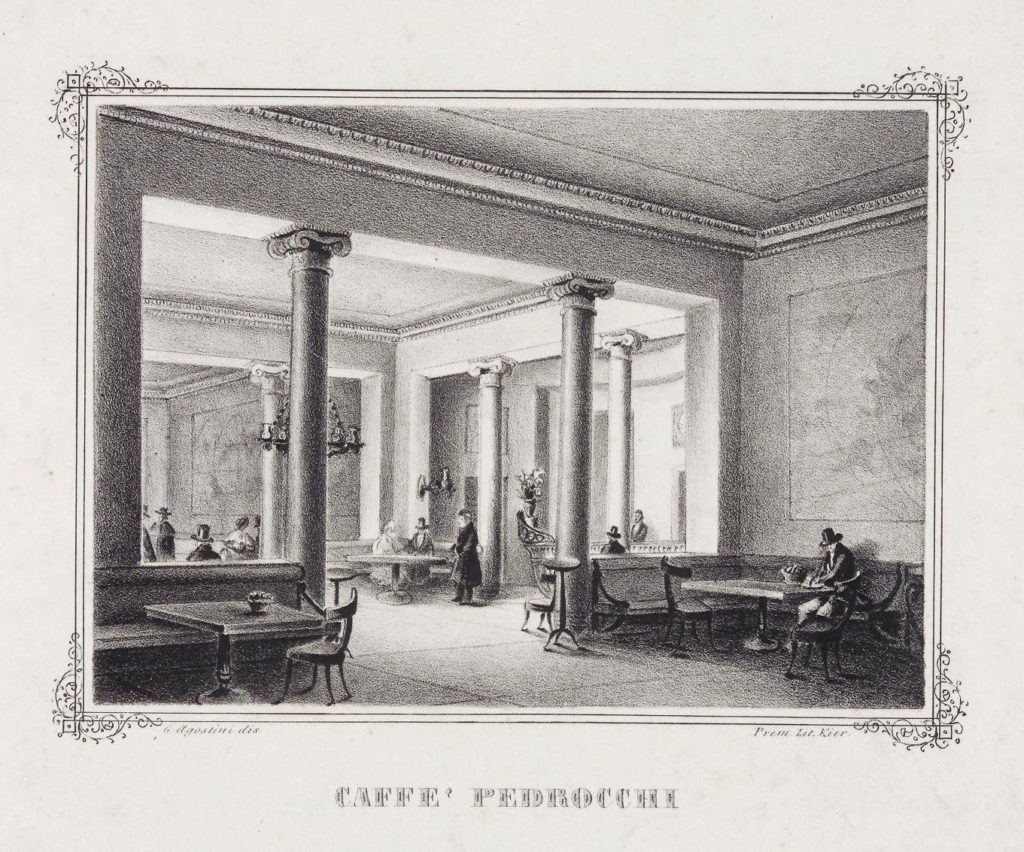
Other than them there were entrepreneurs, merchants and famous people. They came from Paris or Berlin to discuss literature, politics or philosophy, but also about arranged marriages, to show off the latest fashions to high society and take in the sight of a hundred beauties sitting on the sofas of the three halls on the ground floor.
The history of the Pedrocchi Café is, therefore, that of the Grand International Café, having no reason to be jealous of the highly renowned elite cafés of nearby Venice. The presence of many infamous figures can attest to this: Stendhal, Alfred De Musset, George Sand, Gabriele d’Annunzio, Eleonora Duse, Filippo Tommaso Marinetti and many more.
The three halls of Pedrocchi: white, red and green
The three main rooms on the ground floor, the White Room, Red Room and Green Room, got their name from the colour of the tapestry made after the unification of Italy in 1861. Each has its own character.
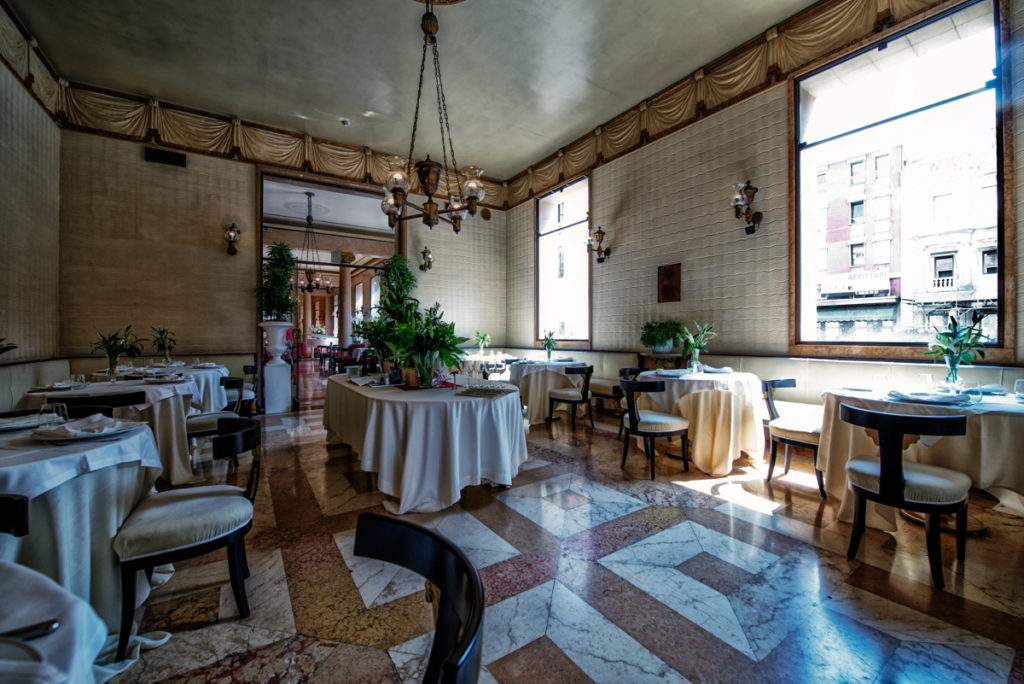
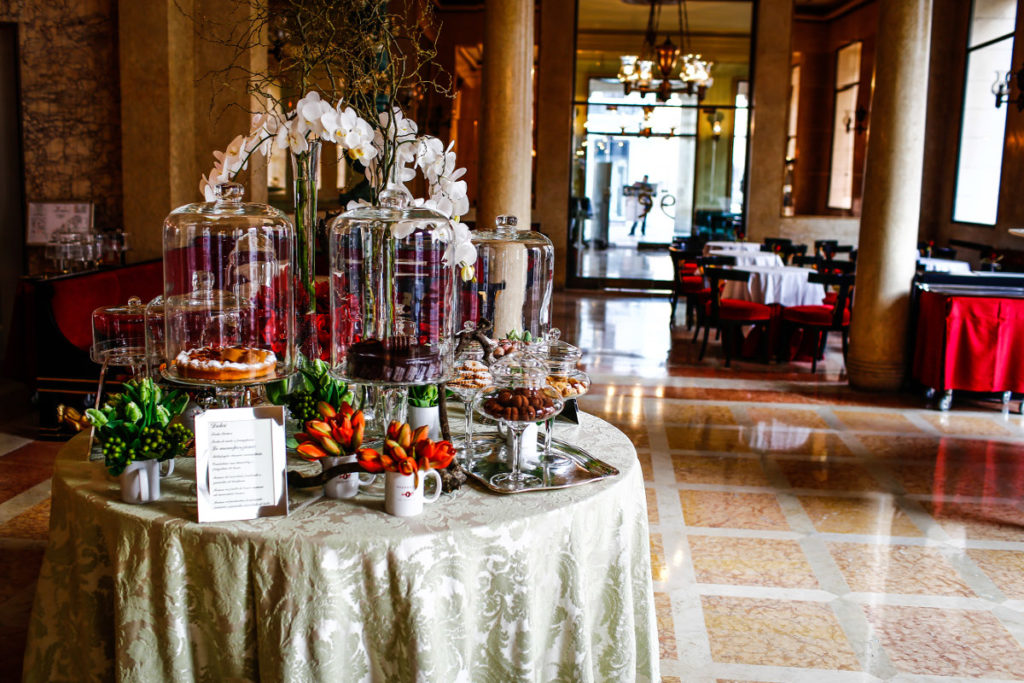
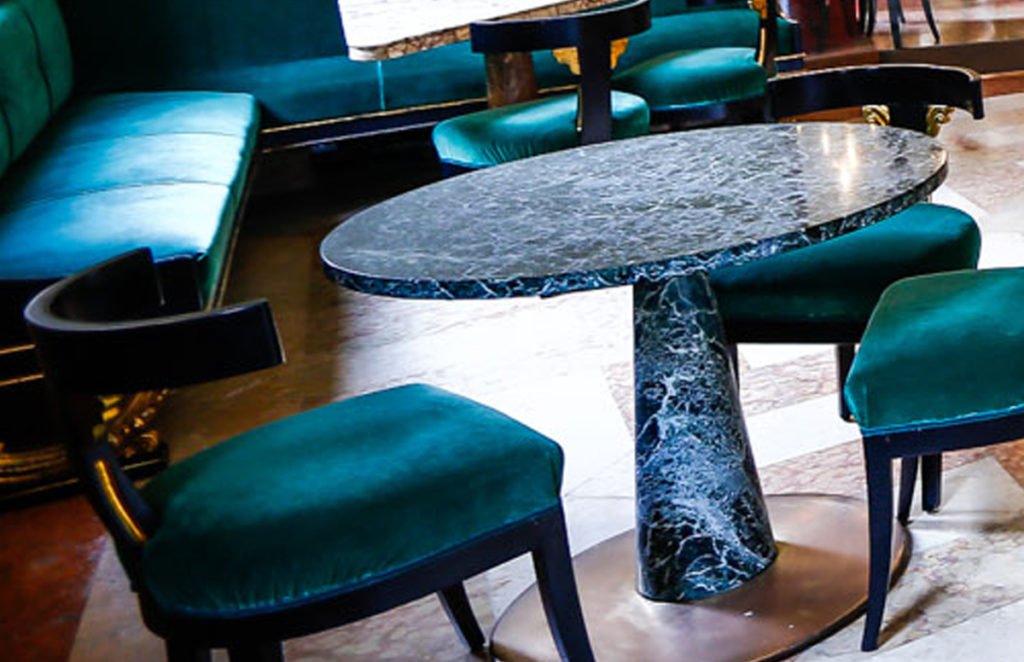
- Green Room: open to everyone, even to the penniless students who could stop here without buying anything but would stop to drink a glass of water and read the newspaper. Right here in fact does the Italian expression “rimanere al verde” (staying in the green), an expression which means being broke. Still today it’s open to whoever wishes to stop and sit down and read the paper without requiring people purchase something.
- Red Room: is the heart of the Pedrocchi Café, with the bar dating back to the original café, made of marble in an oval shape with carved lion’s paws at the end and designed by Jappelli. The still-functioning clock above the bar had a symbolic function in the 1800s: it reminded locals and visitors that this was a café that never closed.
- White Room: here you can see a plaque with a quote by Stendhal on it, a regular at the café, taken from the preface of his novel “The Charterhouse of Parma”: “It was in Padua that I started to see life in a Venetian way, with women sitting in cafés. The illustrious restaurateur Pedrocchi, the best in Italy.” But this isn’t the only part of the story that’s set here…
The Pedrocchi Café and the revolts of the Italian unification
In the Pedrocchi Café’s White Room there is the hole of a bullet stuck wall
Story goes that one morning two Austrian officials passed in front of the Pedrocchi Café, showily waving their lit cigars around. The students, irritated by this obvious act of provocation, snatched the cigar out of the officials’ mouths, shouting: “Down with the cigars!” The military men responded with their weapons, were joined by police officers in the vicinity and the café became the site of a bloody brawl, fought with daggers, pistols and even furniture.
Of these skirmishes, that cost the lives of seven young Paduans and Austrian soldiers, not to mention the expulsion of 73 students and four professors from the university, there remains tangible proof right in the White Room, with a hole where an Austrian bullet once resided.
Still today the event organised by the local students on the 8th of February 1848 is remembered every year by the lively Paduan goliards, with the festival of the change of the “tribuno”, the highest position in the Goliardic university system.
An A+ location
To finish, another curious anecdote: according to a Paduan tradition, whoever enters the Pedrocchi before graduating will be unable to finish their studies. So if you’re planning to stay on track, only enter after you’ve got that piece of paper and can call yourself a graduate…
This tale seems to be linked to the historical period of the 1848 revolts, when two students lost their lives. But for some time now the cafés owners, probably in an attempt to debunk these rumours, have offered preferential treatment aimed directly at students. There’s even a free aperitive for two people: the p31, the typical Pedrocchi aperitive, bright green and offered on the day of an exam that you got top marks for!

Useful information on the Pedrocchi Café
Where is it?
Via VIII Febbraio 15
Distance from ApartmentsPadova: 1.6 km (see map)
Contact information
Website: caffepedrocchi.it
Telephone: 049.8781231
Photos via:
caffepedrocchi.it
Shutterstock.com